
BloxFi Strategic Research Series
Stablecoin On-Ramps and Off-Ramps: How They Work for Businesses
A stablecoin on-ramp turns fiat currency into stablecoins such as USDT or USDC. A stablecoin off-ramp turns stablecoins back into fiat and pays it into a bank account. Together, on-ramps and off-ramps connect stablecoin payments to the banking system.
Payments infrastructure · November 2026 · 12 min read
For a business, the stablecoin transfer in the middle is usually the quick, cheap part. The cost, the waiting and the compliance checks sit mostly at the two ends. This guide explains how a stablecoin on-ramp and off-ramp work step by step, what they cost, how long they take, the rules that apply in 2026, and what to ask a provider before you choose one.
What is a stablecoin on-ramp?
A stablecoin on-ramp is a service that converts fiat money, such as US dollars, euros or pesos, into stablecoins. The business pays in fiat by bank transfer or a local payment method, and receives stablecoins in an approved wallet. On-ramps are also called fiat-to-stablecoin or fiat-to-crypto conversion.
What is a stablecoin off-ramp?
A stablecoin off-ramp does the reverse. It converts stablecoins into fiat currency and pays the money into a bank account, usually over a local payment rail. The off-ramp is where a stablecoin payment becomes money someone can spend.
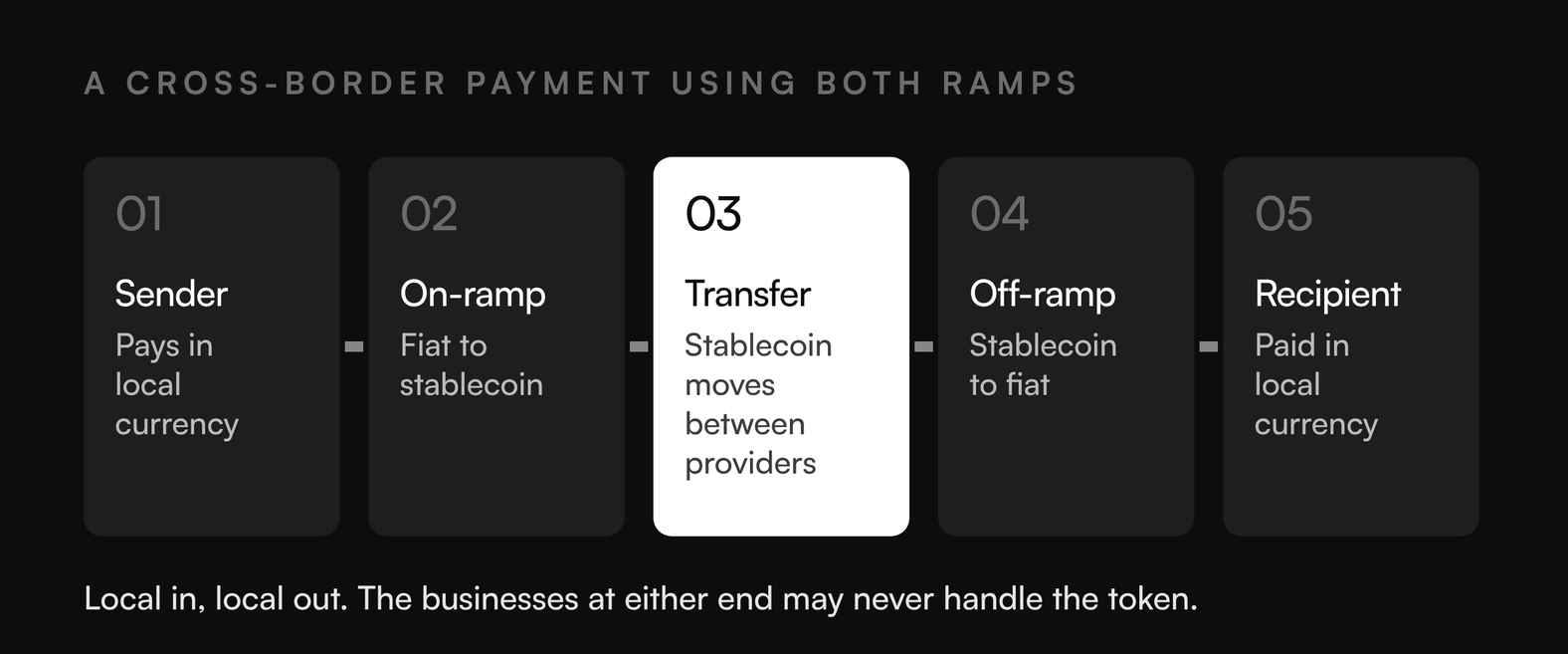
A cross-border payment often uses both. The sender pays in one currency through an on-ramp, the value moves as a dollar stablecoin, and an off-ramp pays the recipient in another currency into a local account. The businesses at either end may never handle the token at all.
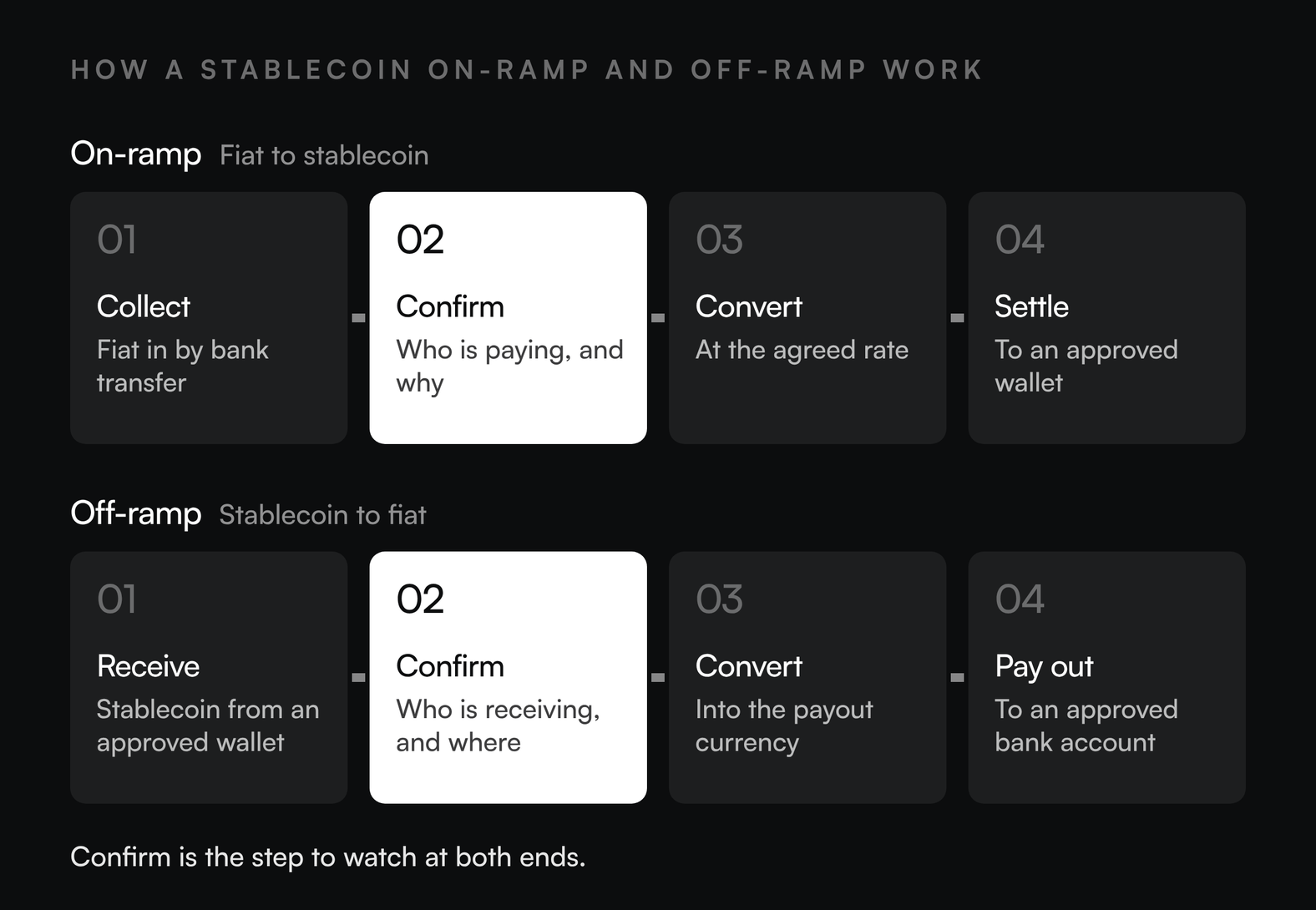
How a stablecoin on-ramp works: four steps
It helps to treat an on-ramp as four checkpoints rather than one conversion:
- 11. Collect. The business sends fiat by bank transfer or a local payment method, usually into an account set up in its own name.
- 22. Confirm. Before anything converts, the provider checks who is paying, whether the paperwork matches and what the payment is for.
- 33. Convert. The fiat is exchanged for a stablecoin at the agreed rate.
- 44. Settle. The stablecoin is sent to a wallet the business has had approved in advance.
In our view, Confirm is the step to watch. A conversion can be priced quickly. A payment whose details don't match the onboarding file can wait for a person to review it.
How a stablecoin off-ramp works: four steps
The off-ramp runs the same rhythm in reverse:
- 11. Receive. The provider receives an approved stablecoin from the business's wallet.
- 22. Confirm. The beneficiary's details are checked: the name, the account, and whether a payment can be made to that account in that country.
- 33. Convert. The stablecoin is exchanged for the payout currency.
- 44. Pay out. Fiat is sent to the approved bank account, over a local payment rail or an international route.
Until the pay-out lands, the recipient has nothing to spend, however quickly the stablecoin moved.
First-party and third-party flows
One question shapes both ramps: whose money is it? First-party means the client's own funds. Third-party means funds from the client's end-customers or counterparties.
Third-party flows usually carry more checks at the Confirm step, because the provider needs to know about people beyond its own client. A business that plans to run customer payments through a stablecoin on-ramp or off-ramp should say so at onboarding, not after its first payment is held.
Stablecoin on-ramp vs off-ramp: the key differences
| Stablecoin on-ramp | Stablecoin off-ramp | |
|---|---|---|
| Direction | Fiat to stablecoin | Stablecoin to fiat |
| What the business sends | Fiat, by bank transfer or a local payment method | Stablecoins, from an approved wallet |
| What arrives | Stablecoins in an approved wallet | Fiat in an approved bank account |
| Main compliance check | Who is paying, and the source of funds | Who is receiving, and where the money is going |
| ypical uses | Funding stablecoin payouts, treasury conversion, collecting customer payments | Paying suppliers and staff, settling cross-border payments, returning funds to a bank |
How businesses use stablecoin on-ramps and off-ramps
Most business use falls into a few patterns:
Cross-border payments. Collect in one currency, move the value as a stablecoin, and pay out in another currency at the other end: local in, local out.
Supplier and contractor payouts. Fund one stablecoin balance, then off-ramp each payment into the recipient's local bank account.
Treasury conversion. Move between fiat and stablecoins for an approved treasury purpose, for example to hold dollars or to settle outside banking hours.
Customer flows. Payment companies, exchanges and fintechs offer on-ramps and off-ramps to their own approved customers.
Trading and settlement. OTC desks and trading firms convert between stablecoins and fiat to settle trades.
How much do stablecoin on-ramps and off-ramps cost?
The cost of a stablecoin on-ramp or off-ramp depends mostly on where the conversion price comes from. A ramp converts in one of two broad ways: through the issuer, or on the market.
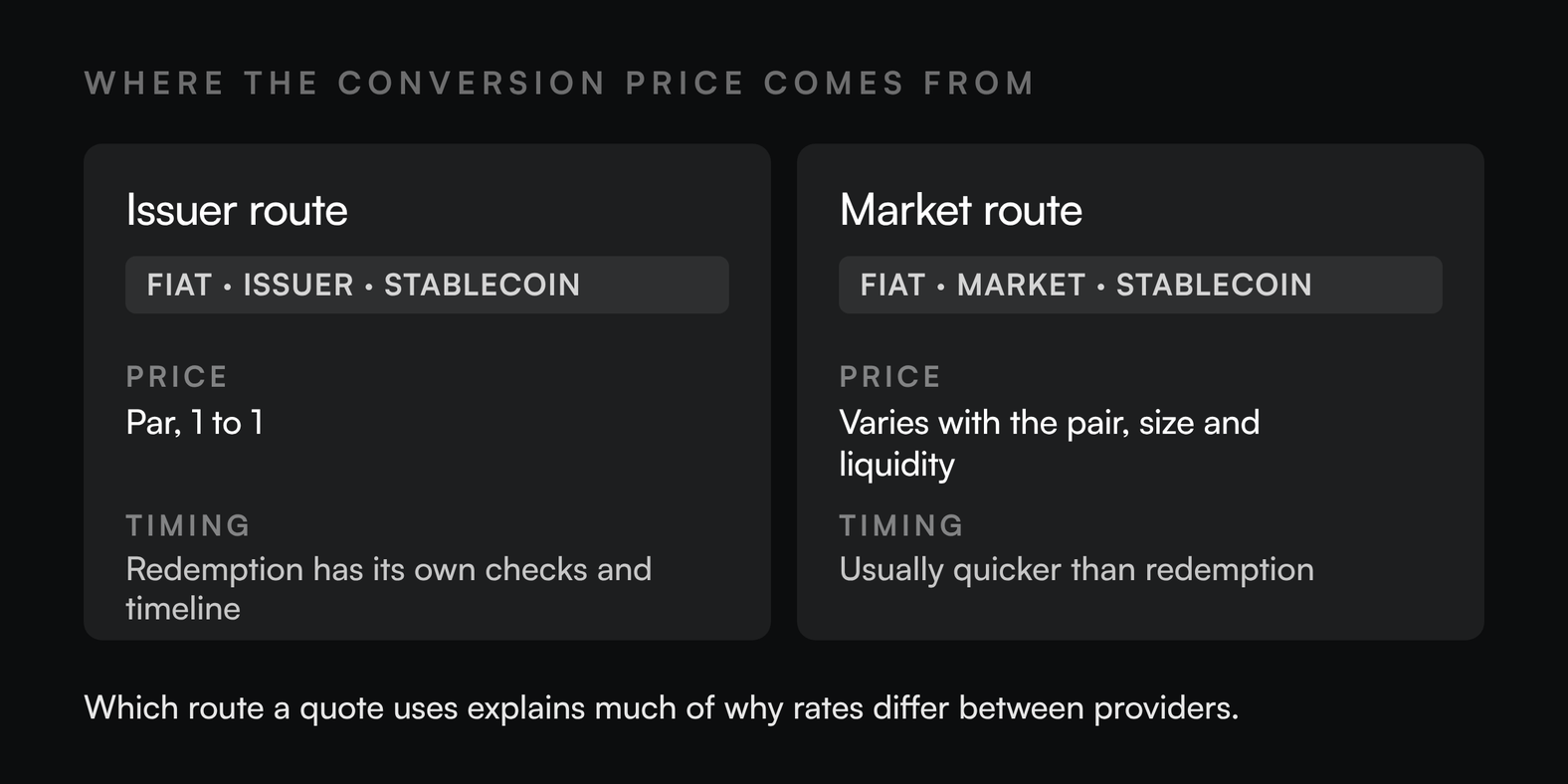
The issuer route
The issuer creates new tokens against the fiat it receives, and redeems tokens for fiat. In the EU, the law sets the issuer's terms. Under Article 49 of MiCA, an e-money token must be issued at par on receipt of funds, and the issuer must redeem it at any time, at par, with no redemption fee.
Par at the issuer isn't the same as par in your account on the same day. Redemption sits behind its own checks and its own clock. Société Générale-FORGE's EURCV white paper is a clear example. It confirms a redemption request within five business days, runs KYC, AML and sanctions checks, and pays out by the last business day of the following month.
The market route
On the market, the ramp buys or sells through exchanges, trading desks and liquidity providers. The rate depends on the currency pair, the transaction size, available liquidity, the payment route and the agreed commercial terms.
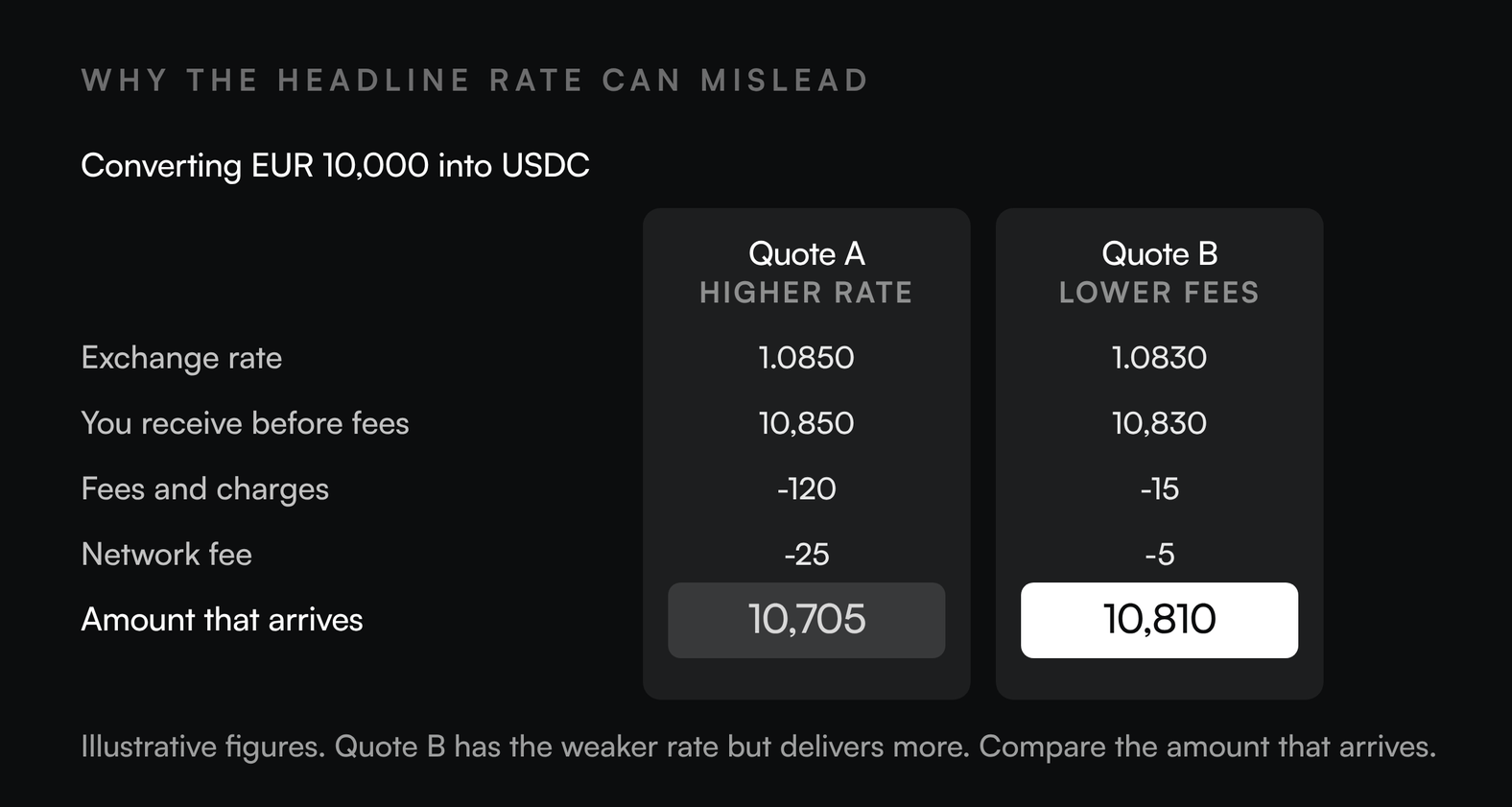
That's why two providers can quote different rates for the same conversion, and why one provider's rate can move during the day. When you compare stablecoin off-ramp or on-ramp quotes, look at the all-in figure:
the exchange rate
every fee and charge, including any network fee
the amount that actually arrives
How long does a stablecoin off-ramp take?
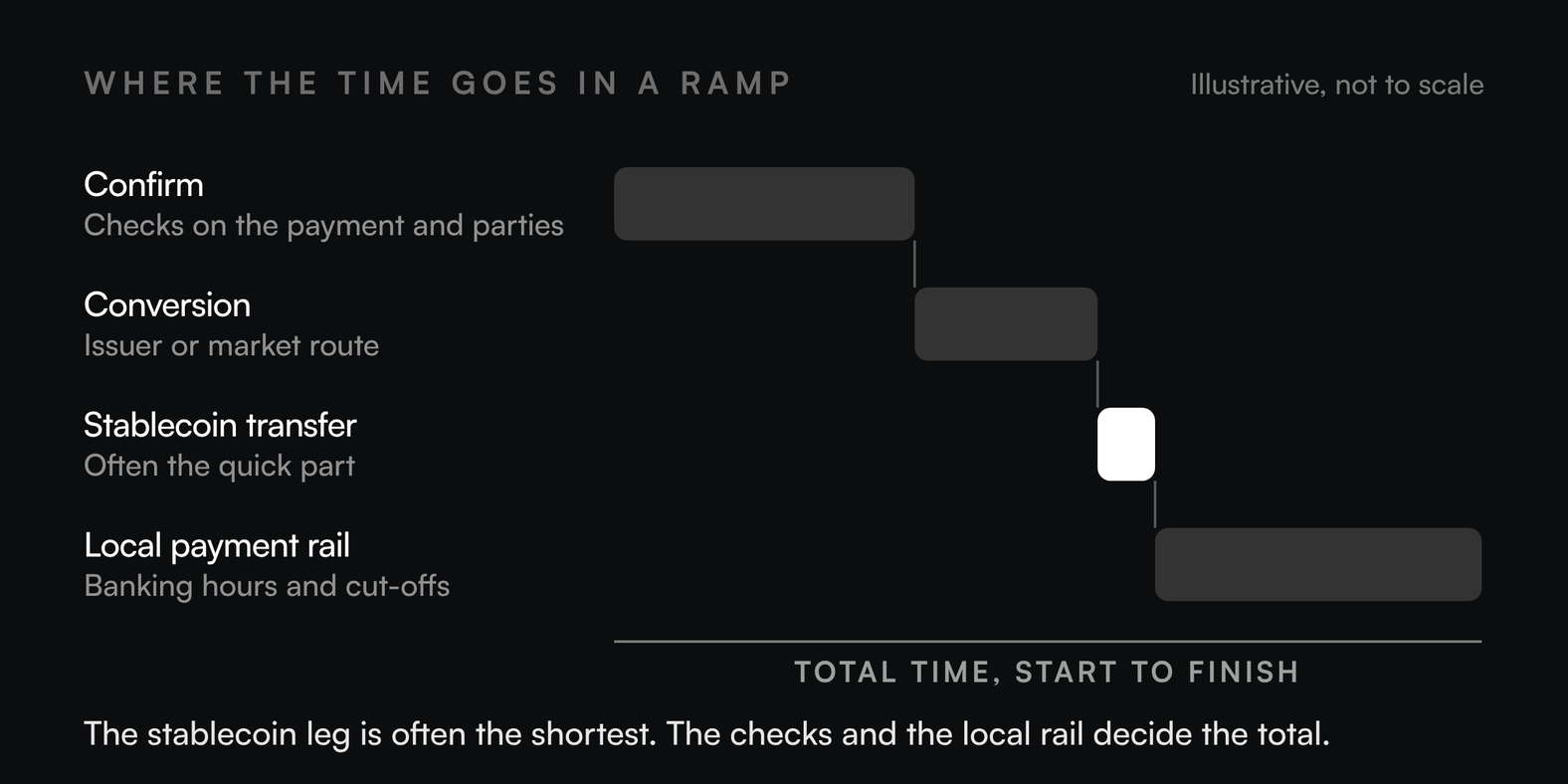
The stablecoin transfer itself can settle in minutes. The total time for an on-ramp or off-ramp depends on four things:
- 1Block 17 · Article: numbered list (one item per entry)
- 21. The Confirm step. A payment that matches the onboarding file moves on; one that doesn't can wait for review.
- 32. The local payment rail. Some local rails run around the clock. Others follow banking hours and cut-off times.
- 43. The corridor. Each currency pair has its own providers, limits and settlement windows.
- 54. The route to the issuer or market. Market conversion is usually quicker than redemption through the issuer.
sk for the settlement window on your specific route, and check how it changes at weekends and outside banking hours.
Why on-ramp and off-ramp coverage differs
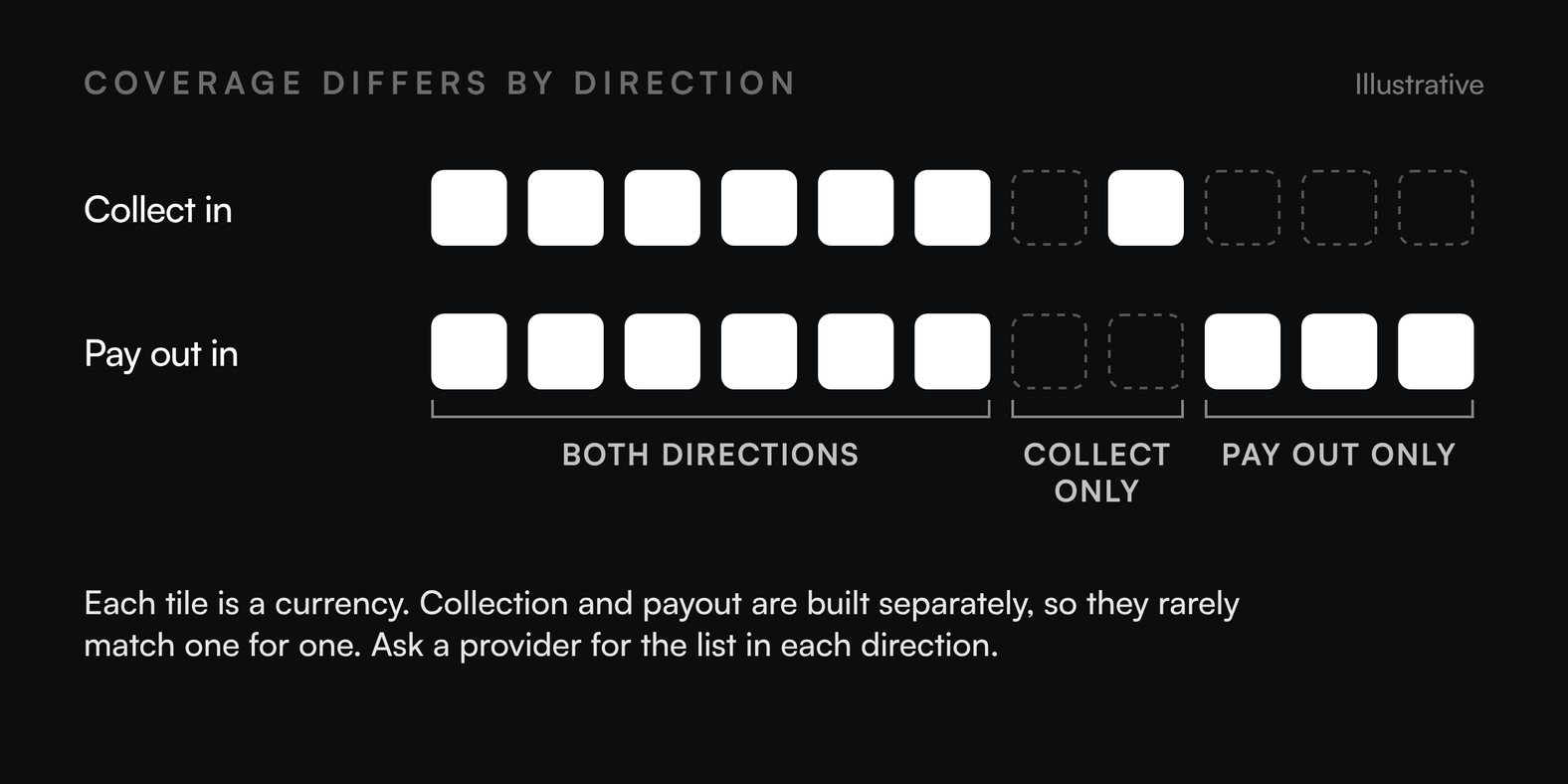
A provider that can pay out in a currency can't necessarily collect in it. Collecting means receiving local payments, which needs accounts and payment methods in that market. Paying out means sending over that market's rails, which needs different arrangements with different partners.
The two sides are built separately, so they rarely match one for one. When you compare providers, ask for the currency list in each direction rather than a single coverage figure.
The same goes for networks. A stablecoin such as USDC or USDT can exist on several blockchains, and a provider supports specific ones on each route. Sending the right token on an unsupported network can delay a payment or put it at risk, so the network in the transfer instructions matters as much as the token.
Stablecoin on-ramp and off-ramp regulation in 2026
Three sets of rules shape what a ramp checks and which stablecoins it may offer.
United States: the GENIUS Act final rule
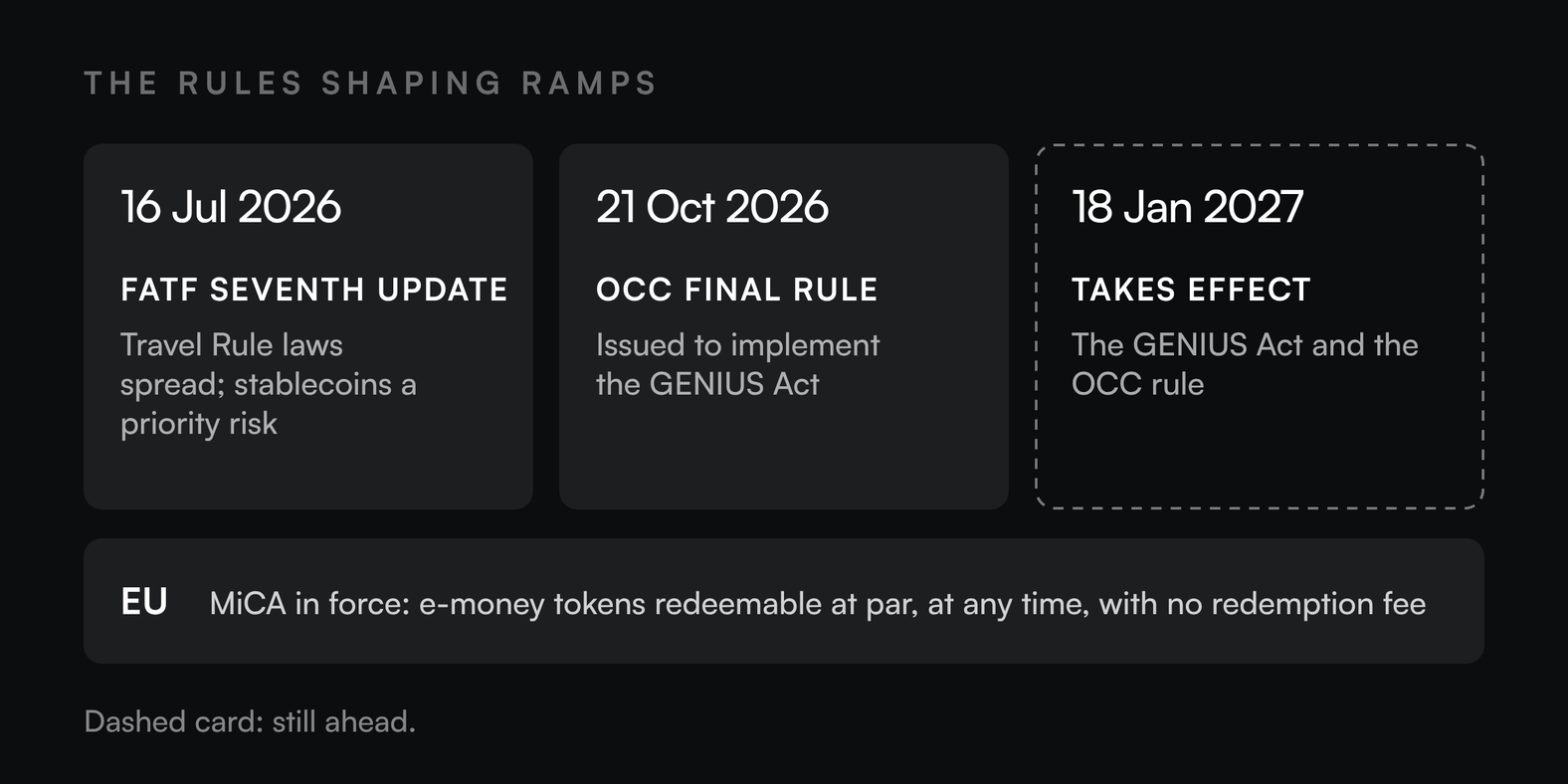
On 21 October 2026 the OCC issued its final rule implementing the GENIUS Act. It takes effect on 18 January 2027, the same day as the Act. From then, the Act generally bars digital asset service providers from offering a payment stablecoin to a person in the United States unless its issuer is permitted, or is a foreign issuer that meets set conditions. The OCC says anti-money laundering and sanctions rules will follow in a separate rulemaking with the Treasury.
For a ramp serving US customers, which stablecoin it may offer is now partly a legal question.
European Union: MiCA
MiCA's redemption rights already apply to e-money tokens issued in the EU, as set out above. Which stablecoins a business can use depends partly on where it and its customers are based.
Global standards: the Travel Rule
The FATF's seventh targeted update on virtual assets, published on 16 July 2026, found that 83% of surveyed jurisdictions have passed laws implementing the Travel Rule, up from 73% in 2025. The rule requires sender and receiver details to pass between providers with a transfer. The FATF also names stablecoins as a priority risk area.
Jurisdictions with Travel Rule laws
2025
2026
Share of jurisdictions surveyed by the FATF that have passed laws implementing the Travel Rule. Source: FATF, 16 July 2026.
In practice, both ramps collect those details at the Confirm step. A payment that arrives without them is the one that waits.
How to choose a stablecoin on-ramp and off-ramp provider
Before you commit volume to any provider, these questions help separate a route that works in practice from one that exists only on paper:
- 11. Which currencies can you collect in, and which can you pay out in? Send both lists.
- 22. Which stablecoins and networks do you support on each route?
- 33. Is the quote all-in: the rate, every charge, and the amount that arrives?
- 44. Does the conversion happen with the issuer, on the market, or both?
- 55. What do you need to confirm a first-party payment, and what changes for third-party flows?
- 66. What are the cut-off times and settlement windows at each end?
- 77. Whose account are the funds in between steps, and under which entity?
Where BloxFi fits
BloxFi is primarily a technology and connectivity platform. Clients onboard with the relevant underlying providers, while BloxFi brings the different providers, corridors and transaction options together through one unified interface.
Both ends of a ramp sit inside that. Through one API, a business can reach stablecoin on-ramps from fiat into stablecoins and off-ramps from stablecoins back into fiat, with more than 30 local currencies available. Smart routing compares connected providers for each payment. For cross-border payments, the two ends connect in one flow: local in, local out. Businesses can also create named accounts, and compliance and on-chain checks are part of the flow. The Fiat  Stablecoin page sets out how it works.
Availability, payment rails, limits and timing are confirmed per client following KYB and compliance review. The Compliance page sets out what's needed at each onboarding stage.
If you're mapping corridors, talk to the BloxFi team about which routes are available for your business.
Frequently asked questions
What is the difference between a stablecoin on-ramp and an off-ramp?
A stablecoin on-ramp converts fiat into stablecoins. A stablecoin off-ramp converts stablecoins back into fiat and pays it into a bank account. A cross-border payment often uses both, one at each end.
Is a stablecoin on-ramp the same as a crypto on-ramp?
A stablecoin on-ramp is one kind of crypto on-ramp. It converts fiat into a stablecoin, a token designed to hold a steady value against a currency such as the US dollar, rather than into a volatile cryptocurrency.
Which stablecoins do on-ramps and off-ramps support?
USDT and USDC are the most widely supported, as the two largest stablecoins. Support varies by provider, route and network, so check both the token and the network before you send.
How long does an off-ramp payment take to arrive?
It depends on the provider, the corridor, the checks at the Confirm step and the local payment rail. Ask for the settlement window on your specific route, and check how it changes outside banking hours.
Why do providers quote different rates for the same conversion?
Rates depend on the currency pair, the transaction size, the liquidity available at that moment and the provider's commercial terms. Compare the all-in amount that arrives, not the headline rate.
Does my business need its own wallet?
For an on-ramp that ends in stablecoins, yes: the tokens settle to a wallet approved in advance. In a payment that's collected and paid out in local currency, the stablecoin leg can run between providers without the business holding the token.
Do stablecoin on-ramps and off-ramps need KYC or KYB?
Yes. Regulated providers verify the business (KYB) and check the people and payments involved before they convert or pay out. Third-party flows usually need more checks than a business moving its own funds.
Are stablecoin on-ramps and off-ramps regulated?
Increasingly, though the rules differ by country. The FATF covers stablecoins in its work on virtual assets, the EU applies MiCA, and the US GENIUS Act takes effect on 18 January 2027.
Sources field (after the Body)
Paste as a bulleted list. Each line is a link.